

Impact of Data Privacy Regulations on Software Development
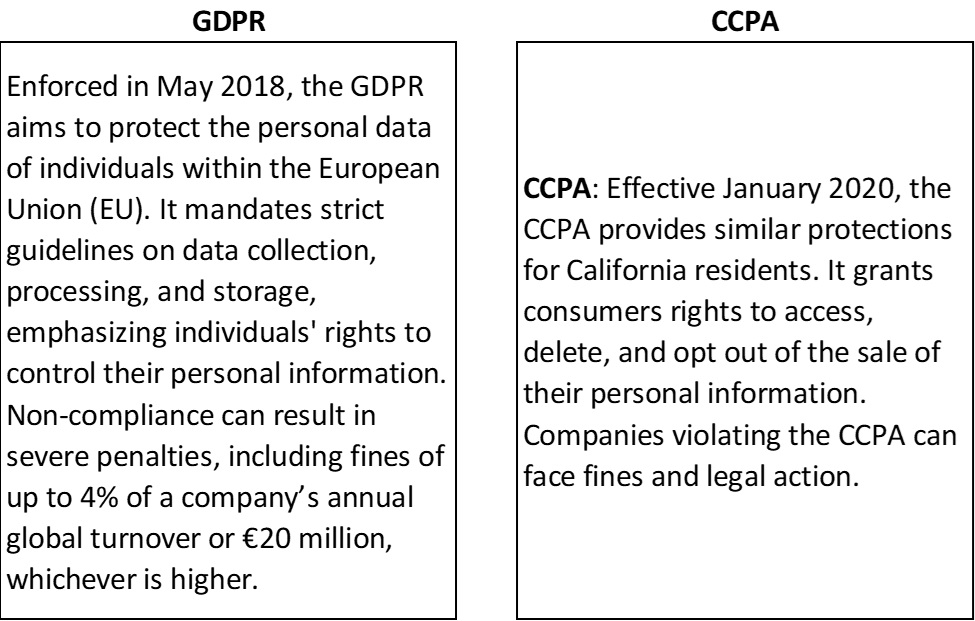
In a recent article, we talked about data security risks. And within the set of data security, data privacy has become a critical concern in the digital age, leading to the establishment of stringent regulations such as the General Data Protection Regulation (GDPR) in Europe and the California Consumer Privacy Act (CCPA) in the United States. These regulations have significantly impacted software development practices, compelling companies to prioritize data privacy and security. In this article, we will explore the influence of GDPR and CCPA on software development and how companies ensure compliance with these regulations.
Understanding GDPR and CCPA
Impact on Software Development Practices
Data Minimization and Purpose Limitation: GDPR and CCPA advocate for data minimization, where only the necessary data is collected for specific purposes. Software developers now design systems that collect minimal data and clearly define their purpose, reducing the risk of non-compliance.
Privacy by Design and Default: GDPR’s principle of Privacy by Design requires that data protection measures are integrated into the development process from the outset. Developers must consider privacy implications at every stage of development, ensuring that systems are secure by default.
Enhanced Security Measures: To comply with GDPR and CCPA, developers implement robust security measures, including encryption, pseudonymization, and regular security assessments. This protects personal data from breaches and unauthorized access.
User Consent Management: Obtaining explicit consent from users for data collection and processing is a cornerstone of GDPR. Developers must create user-friendly interfaces that facilitate informed consent, including options for users to withdraw consent easily.
Data Access and Portability: Both regulations emphasize individuals’ rights to access their data and request its transfer to another service provider. This necessitates developing features allowing users to download their data in a structured, commonly used format.
Incident Response and Breach Notification: GDPR requires companies to report data breaches within 72 hours. Software developers must build systems capable of promptly detecting, responding to, and reporting violations, ensuring regulatory compliance.
Data Subject Rights: GDPR and CCPA grant individuals rights to access, rectify, delete, and restrict the processing of their data. Developers need to ensure that systems can accommodate these requests efficiently.
Ensuring Compliance
Regular Audits and Assessments: Companies conduct regular audits and assessments of their data handling practices to identify and rectify potential compliance issues promptly. This includes code reviews, security assessments, and privacy impact assessments.
Training and Awareness: It is crucial to ensure that all employees, including developers, are aware of data privacy regulations. Regular training sessions and workshops help keep teams updated on the latest requirements and best practices.
Data Protection Officers (DPOs): GDPR mandates the appointment of a Data Protection Officer for certain organizations. The DPO oversees compliance efforts, conducts regular audits, and acts as a liaison with regulatory authorities.
Robust Documentation: Maintaining comprehensive documentation of data processing activities is not just a requirement but a demonstration of our commitment to transparency and accountability. Companies must document data flows, consent records, and implemented data protection measures, providing stakeholders with a clear view of our compliance efforts.
Third-Party Management: Companies often work with third-party vendors for various services. Ensuring that these vendors also comply with GDPR and CCPA is vital. This involves conducting due diligence, signing data processing agreements, and regularly reviewing their practices.
Technology Solutions: Leveraging technology solutions such as privacy management software can streamline compliance efforts. These tools assist in tracking data processing activities, managing user consent, and automating compliance reporting.
Conclusion
The implementation of data privacy regulations like GDPR and CCPA has fundamentally reshaped software development practices. Companies must prioritize data privacy and security, integrating compliance measures throughout the development lifecycle. By adopting best practices and leveraging technology, organizations can ensure they meet regulatory requirements, protect user data, and maintain consumer trust.
I hope this article has been helpful to you. If you liked it or want to learn more about Deproinf, please subscribe to stay updated.
Subscribe to DeproinfIf you have specific needs, please GIVE US YOUR INFORMATION and we will contact you as soon as possible.
