
Low-Code/No-Code Development: Empowering Non-Technical Users
Low-code/no-code development platforms have become game-changers in the software industry. These platforms are democratizing software development by enabling non-technical users to create applications without needing extensive programming knowledge. In this article, I explain what low-code/no-code is, how it can decrease development times, and what could be the future of these platforms.
What Are Low-Code/No-Code Platforms?
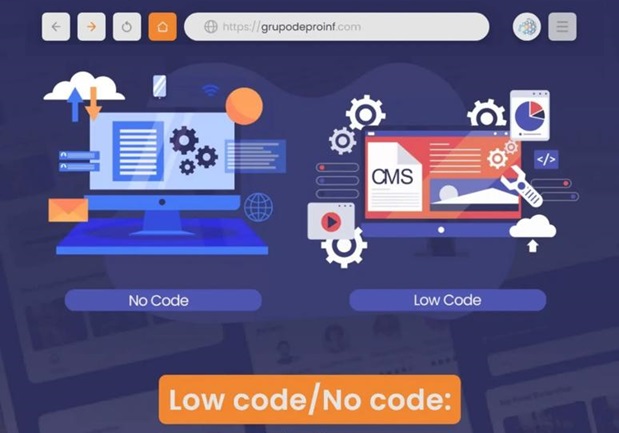
Low-code platforms provide a development environment where users can build applications using a mix of pre-built templates, drag-and-drop components, and custom code when necessary. While low-code platforms may still require some programming knowledge, they drastically reduce the amount of manual coding needed, making it accessible to semi-technical users.
No-code platforms go a step further, allowing users with no coding experience to create fully functional applications. No-code platforms rely entirely on visual elements and intuitive interfaces, such as forms, dashboards, and workflows, to design and launch applications without writing a single line of code.
Democratizing Software Development
Traditionally, software development has been the domain of professional developers, often requiring specialized knowledge of programming languages, frameworks, and databases. Low-code and no-code platforms are changing that by breaking down the technical barriers that have long restricted non-developers from contributing to software projects.
Business users, project managers, marketers, and other non-technical stakeholders can now participate in the application development process. This democratization of software development allows organizations to:
Empower non-technical staff: Employees who understand business needs but may lack coding skills can now build the applications they need to solve specific problems.
Reduce dependency on IT teams: With more people involved in development, IT departments can focus on more complex and strategic tasks instead of being bottlenecked by routine application requests.
Foster innovation: When more people have the tools to experiment with new ideas, innovation can happen more rapidly. Low-code and no-code platforms create opportunities for “citizen developers” to test and iterate on new concepts with minimal investment.
Accelerating the Development Process with Low-Code/No-Code Platforms
In different articles, we have explored the importance of accelerating the app development cycle. One of the most significant advantages of low-code and no-code platforms is the speed at which applications can be developed. By automating many aspects of traditional coding and providing pre-built components, these platforms allow users to:
Develop applications faster: The visual interfaces and reusable modules in low-code and no-code platforms streamline the development process, enabling users to build and deploy applications in days or weeks instead of months.
Rapid prototyping and iteration: Users can quickly create prototypes to test ideas, gather feedback, and iterate on the application’s design before committing to a final version. This approach leads to faster improvement cycles and better alignment with user needs.
Adapt to existing systems with ease: Many low-code and no-code platforms offer built-in integrations with popular third-party applications, databases, and services. This seamless integration allows users to connect their new applications to existing systems without the need for complicated back-end development.
Use Cases and Benefits
Low-code and no-code platforms are versatile and can be used across various industries and business functions. Some common use cases include:
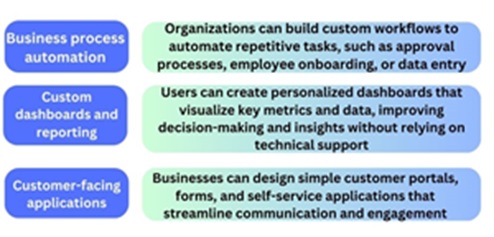
The benefits of adopting these platforms include:
Cost efficiency: Developing applications in-house with non-technical staff reduces the need for external software development resources and cuts costs.
Increased agility: Businesses can respond more quickly to market or internal needs changes, as non-technical teams can modify and update applications without waiting for developers.
Improved collaboration: With more stakeholders involved in the development process, cross-functional teams can work more effectively together, ensuring that applications meet both technical and business requirements, thereby enhancing the team’s effectiveness.
Challenges and Considerations
While low-code and no-code platforms offer many advantages, there are also some challenges to consider:
Complexity limitations: While these platforms are excellent for simple to moderately complex applications, they may not be well-suited for building large-scale, complex enterprise systems.
Customization constraints: Users may encounter limitations in customizing certain features or functionalities, particularly with no-code platforms, which offer less flexibility for adding custom code.
One of the key challenges of low-code and no-code platforms is the potential risks associated with non-technical users developing applications. Without proper oversight and governance, these platforms can introduce security, data integrity, and compliance risks.
The Future of Low-Code/No-Code Platforms
As the demand for software grows, low-code and no-code platforms are expected to play an increasingly important role in the future of development. Advances in artificial intelligence and machine learning may further simplify these platforms, making them even more powerful and accessible.
Through low-code and no-code platforms, Deproinf can empower businesses to adapt, innovate, and scale in previously unimaginable ways for non-technical teams.
I hope this article has been helpful to you. If you liked it or want to learn more about Deproinf, please subscribe to stay updated.
Subscribe to DeproinfIf you have specific needs, please GIVE US YOUR INFORMATION and we will contact you as soon as possible.
