
Edge Computing in IoT Solutions: Enhancing Data Processing
The Internet of Things (IoT) has revolutionized industries by enabling connected devices to collect, analyze, and act upon data. However, as the number of IoT devices grows, traditional cloud-based processing faces significant challenges, including high latency, bandwidth limitations, and security concerns. In this article, I explore how edge computing in IoT can offer a solution that enhances IoT performance by processing data closer to the source.
The Challenge of Cloud-Centric IoT:
In a traditional cloud-based IoT setup, data generated by devices is transmitted to a centralized cloud server for processing. While this approach offers scalability and centralized management, it suffers from several limitations:
Latency: The round trip to the cloud and back can introduce significant delays, especially critical for time-sensitive applications like autonomous vehicles or industrial control systems.
Bandwidth Constraints: Transmitting massive amounts of raw data to the cloud consumes significant bandwidth, which can be costly and impractical, particularly in areas with limited connectivity.
Security Risks: Centralizing all data in the cloud creates a single point of vulnerability, making it a prime target for cyberattacks.
Limited Offline Functionality: Devices reliant on cloud connectivity become useless when the network is down, hindering critical operations.
What is Edge Computing?
Edge computing refers to a distributed IT architecture that brings computation and data storage closer to the location where it is needed, rather than relying solely on a centralized cloud. By enabling data processing at the device level or near the network’s edge, edge computing significantly reduces the time needed for data to travel to the cloud and back.
Key Benefits of Edge Computing in IoT
Reduced Latency: Latency is a critical factor in IoT applications, especially in industrial automation, healthcare, autonomous vehicles, and smart cities. With edge computing, data is processed locally, eliminating the delays caused by sending information to a remote cloud server. This real-time capability allows for instant decision-making in applications such as predictive maintenance, autonomous driving, and real-time health monitoring.
Improved Data Processing and Efficiency: Edge computing optimizes bandwidth usage by processing only relevant data at the edge while sending critical insights to the cloud. This is particularly beneficial in environments with limited connectivity or high network costs, such as remote industrial sites, oil rigs, and agricultural monitoring systems.
Enhanced Security and Privacy: IoT devices often handle sensitive data, such as patient health records or financial transactions. Sending all this data to the cloud increases vulnerability to cyber threats. Edge computing enhances security by keeping data processing local, reducing exposure to potential attacks, and ensuring compliance with privacy regulations such as GDPR and HIPAA.
Scalability and Flexibility: As IoT networks expand, cloud infrastructure alone may struggle to keep up with the growing volume of data. Edge computing allows for scalable and decentralized processing, ensuring IoT systems can handle increasing workloads without overwhelming centralized data centers.
Reliable Operations in Low-Connectivity Areas: IoT applications deployed in rural areas, offshore facilities, and underground mines often suffer from unstable network connectivity. Edge computing ensures that devices continue operating and making intelligent decisions even when disconnected from the cloud, enhancing reliability and uptime.
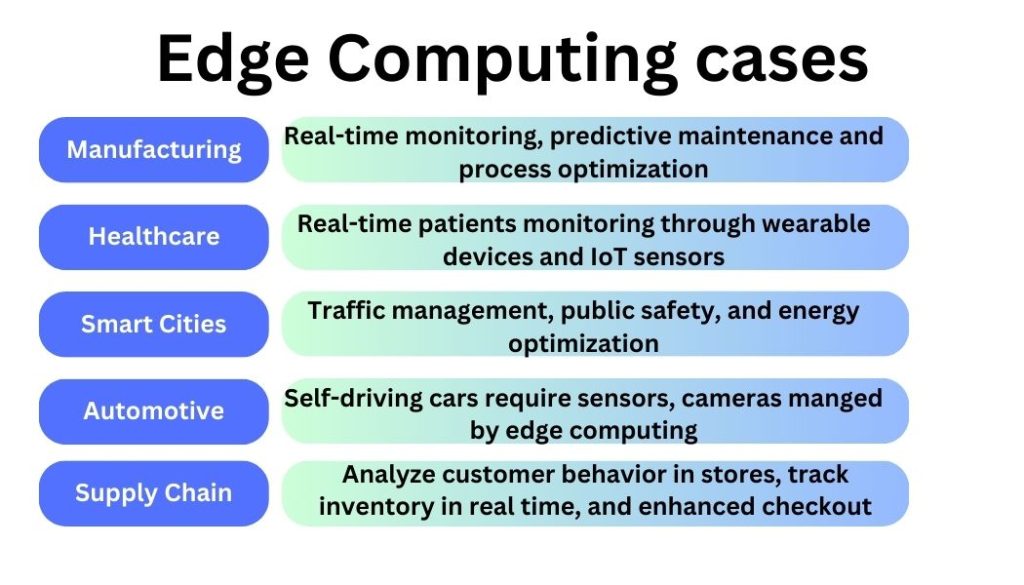
Use Cases of Edge Computing in IoT
Challenges and Considerations of Edge Computing in IoT
While edge computing brings numerous advantages, its adoption comes with challenges:
Device Management Complexity: Managing and updating thousands of edge devices across different locations requires robust orchestration and monitoring solutions.
Security Risks at the Edge: While data remains local, edge devices can still be vulnerable to cyber threats if not properly secured. Regular firmware updates, encryption, and secure authentication are necessary to mitigate risks.
Initial Deployment Costs: Implementing edge infrastructure requires an initial investment in hardware, software, and integration, but long-term cost savings can outweigh these expenses.
Conclusion
Edge computing is transforming the IoT landscape by addressing the limitations of traditional cloud-centric architectures. Bringing computation closer to the edge empowers IoT solutions with reduced latency, improved bandwidth utilization, enhanced security, and increased reliability. As edge computing technology continues to mature, it will play a pivotal role in unlocking the full potential of the IoT and driving innovation across a wide range of industries.
I hope this article on edge computing in IoT has been helpful to you. If you liked it or want to learn more about Deproinf, please subscribe to stay updated.
Subscribe to DeproinfIf you have specific needs, please GIVE US YOUR INFORMATION and we will contact you as soon as possible.
