
Serverless Architecture: Unleashing Efficiency in the Digital Age
Serverless architecture represents a paradigm shift in application development and deployment. This new architecture is changing the game by allowing developers to focus solely on building their application without worrying about the infrastructure behind it. In this article, I explain the challenges of this novel architecture, comparing it to traditional server-based approaches.
Serverless vs. Traditional Server-Based Architecture
In traditional server-based architecture, developers must manage and maintain physical or virtual servers. These servers require constant monitoring, scaling, and maintenance, which can be time-consuming and resource-intensive. Scaling to accommodate changes in demand often involves adding or removing servers, a process that can be slow and costly.
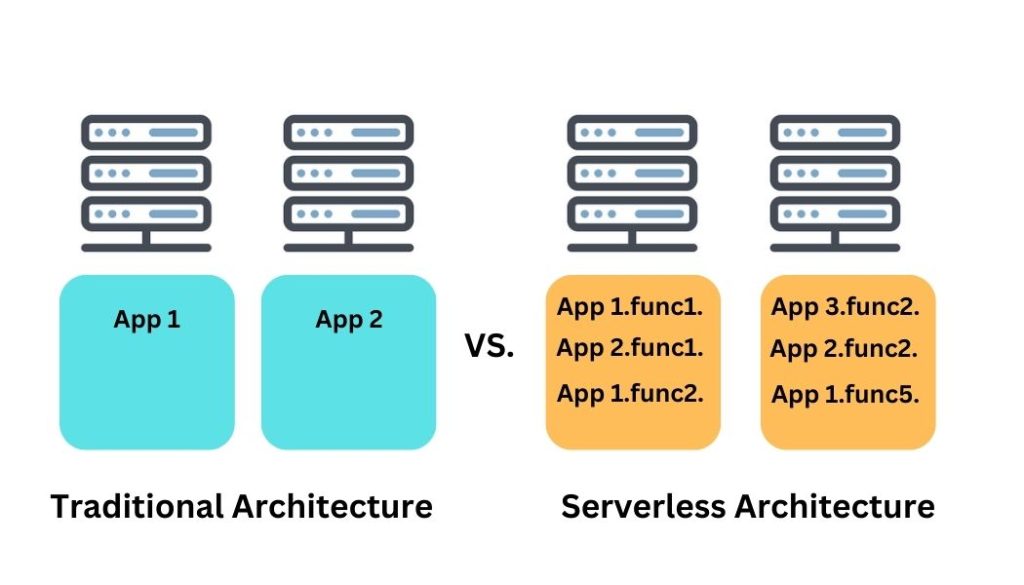
Serverless architecture, in contrast, abstracts the infrastructure layer away from developers. In a serverless model, cloud providers handle server provisioning, scaling, and maintenance. Developers write code in the form of functions, and these functions run in response to events triggered by various sources, such as HTTP requests or database changes. Serverless computing is often associated with Function as a Service (FaaS) platforms like AWS Lambda, Azure Functions, or Google Cloud Functions.
The figure illustrates the concept.
Benefits of Serverless Architecture
Cost Efficiency: Serverless architectures operate on a pay-as-you-go model, where you only pay for the computing resources used during the execution of functions. This scheme eliminates the need for provisioning and maintaining servers, resulting in cost savings, especially for applications with variable workloads.
Scalability and Elasticity: Serverless platforms automatically handle scaling. Functions can scale horizontally to accommodate increasing workloads without manual intervention. This elasticity ensures that applications remain responsive even during traffic spikes.
Reduced Operational Overhead: Developers can focus primarily on writing code rather than managing infrastructure, which streamlines development processes, accelerates time to market, and reduces operational overhead.
High Availability: Serverless platforms often provide built-in redundancy and failover mechanisms. This means that functions can run in multiple availability zones, enhancing the availability and reliability of applications.
Event-Driven and Microservices-Friendly: Serverless architectures encourage a Microservices approach, where applications are broken down into smaller, loosely coupled components. Event-driven processing enables seamless integration with various services and systems.
Challenges of Serverless Architecture
Cold Starts: Serverless functions may experience a latency known as a “cold start” when triggered for the first time or after being idle. This latency can impact the responsiveness of applications, particularly those with strict real-time requirements.
Limited Execution Time: Serverless platforms impose limits on the execution time of functions, typically ranging from a few seconds to a few minutes. Long-running processes may need to be broken into smaller functions.
Vendor Lock-In: Adopting a serverless platform often involves vendor-specific services and tools, which can lead to vendor lock-in, making it challenging to migrate applications to another cloud provider.
Debugging and Monitoring: Debugging and monitoring serverless functions can be more complex than traditional server-based applications. Tools and practices need to evolve to effectively troubleshoot and monitor distributed, event-driven systems.
Conclusion
Choosing serverless architecture should align with your specific use case and requirements. For applications with variable workloads, sporadic usage patterns, or the need for rapid development and scaling, serverless can be a game-changer. However, for applications with stringent real-time requirements or long-running processes, traditional server-based approaches may still have a role to play.
I hope this article on technology trends has been helpful to you. If you liked it or want to learn more about Deproinf, please subscribe to stay updated.
Subscribe to DeproinfIf you have specific needs please GIVE US YOUR INFORMATION and we will contact you as soon as possible.
