
Microservices Architecture: Unleashing the Power of Modular Software Development
Microservices Architecture was first mentioned in 2011, and its use has consistently grown as a transformative approach that offers unparalleled flexibility, scalability, and efficiency in software development. In this article, I explore the fundamental concepts, benefits, challenges, and best practices of Microservices Architecture in software development.
Understanding Microservices Architecture
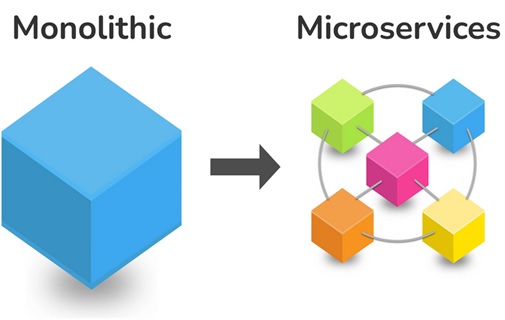
Microservices Architecture is a design pattern where a complex application is broken down into smaller, loosely-coupled services that are developed, deployed, and maintained independently. Each service is responsible for a specific business capability and communicates with others through well-defined APIs.
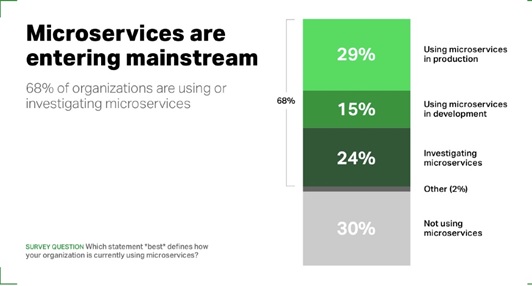
A survey conducted by NGINX shows the growth in the adoption of Microservices among development companies.
This modular approach contrasts with traditional monolithic architectures, where a single codebase handles all functions of the application.
Benefits of Microservices Architecture
Microservices architecture and digital transformation are closely intertwined concepts, each influencing and supporting the other in modern software development and business evolution. These are some of the benefits that Microservices offer.
Scalability: Microservices allow independent scaling of individual services based on demand, which ensures efficient resource utilization and cost savings, as only the necessary components are scaled.
Flexibility and Agility: Teams can work on individual services without impacting others, enabling rapid development, testing, and deployment. This agility is especially valuable in a fast-paced development environment.
Resilience: Isolating services prevents a single service failure from affecting the entire application. Fault tolerance is enhanced as services can be designed to handle failures independently.
Technology Diversity: Different services can be developed using diverse technologies, enabling teams to choose the best-suited tools for each task.
Easier Maintenance: With smaller focused codebases, maintaining and updating services becomes more manageable, reducing the risk of introducing bugs during updates.
Challenges to Consider
Adopting Microservices has its challenges. These are the top 5 challenges we have encountered.
Complexity of Distributed Systems: Microservices introduce a network of interconnected components, which can increase the complexity of system monitoring, debugging, and communication.
Data Management: Handling data consistency across services can be challenging, requiring careful design of data synchronization and storage strategies.
Service Discovery: Managing service discovery, load balancing, and inter-service communication require dedicated solutions to avoid bottlenecks.
Operational Overhead: Running and monitoring multiple services necessitates robust deployment, monitoring, and logging strategies.
Security: Securing communication between services and managing access controls becomes critical in a distributed environment.
Best Practices for Microservices Development
If you decide to embrace Microservices architecture, we recommend considering the following practices.
Define Clear Service Boundaries: Design services based on well-defined business capabilities to ensure clear separation of concerns.
API First Approach: Prioritize designing stable and well-documented APIs to foster seamless communication between services.
Decentralized Data Management: Use dedicated databases for each service and employ asynchronous data synchronization methods to maintain data consistency.
Automated Testing and Continuous Integration: Implement automated testing for each service, and incorporate a CI/CD pipeline to ensure rapid and reliable deployments.
Monitoring: Implement comprehensive monitoring, logging, and tracing mechanisms to gain insights into the performance and behavior of services.
I hope this article on Microservices for software development has been helpful to you. If you liked it or want to learn more about Deproinf, please subscribe to stay updated.
Subscribe to DeproinfIf you have specific needs please GIVE US YOUR INFORMATION and we will contact you as soon as possible.
