

Outsourcing Trends: Joining the outsourcing software development wave
In a recent article, I explained why software outsourcing will continue rising. In this article, I will navigate the outsourcing trends and projections backed up with statistics that will shed light on why organizations should seriously consider joining the outsourcing wave.
Global Outsourcing Trends
The outsourcing industry has experienced remarkable growth and transformation on a global scale. According to a report by Grand View Research, the global IT outsourcing market size was valued at USD 333.7 billion in 2020 and projects to expand at a compound annual growth rate (CAGR) of 7.8% from 2021 to 2028. These statistics highlight the upward trajectory of outsourcing, emphasizing its increasing significance in the business world.
Outsourcing trends in the United States
The United States has played an important role in IT outsourcing as both an outsourcing service provider and a country seeking outsourced services. According to Statista, the total value of IT services and business process outsourcing (BPO) deals in the United States amounted to USD 37.7 billion in 2020. Outsourcing trends in the US market will continue growing due to factors like cost-efficiency, access to specialized skills, and scalability.
Outsourcing trends based on facts
Two outsourcing trends stand above the rest:
- Outsourcing will continue growing
- Nearshoring will continue gaining ground over offshoring and homeshoring.
In this section, I will explain why.
Reasons to Outsource
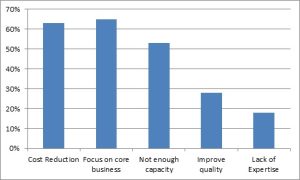
From the graph we can see that Cost reduction is the main reason for outsourcing projects. The cost reduction stems from two elements:
- The complexity of hiring and retaining software specialists in an environment characterized by an unbalance between demand and supply. As shown in the graph below courtesy of the US Bureau of Labor Statistics.
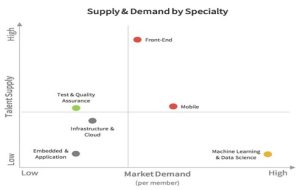
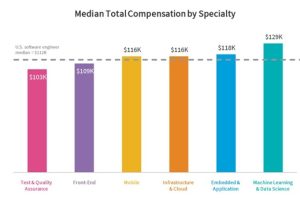
- The increased cost of software specialists stems from the unbalance referred to above. The graph below reflects this reality.
The cost reduction from offshoring project developments is between 30% and 60%, depending on the region. But the drawback is the time difference and cultural variation.
The cost reduction from nearshoring project developments is between 345% and 70%, depending on the country, without the drawbacks associated with offshoring.
Deproinf updating policies
At Deproinf, our unwavering commitment to continuous improvement empowers us to stay at the forefront of development trends, ensuring that our team remains highly skilled and up-to-date. Our clients benefit from cutting-edge solutions, innovative approaches, and streamlined processes that optimize efficiency and quality.
I hope this article on has been helpful to you. If you liked it or want to learn more about Deproinf, please subscribe to stay updated.
Subscribe to DeproinfIf you have specific needs please GIVE US YOUR INFORMATION and we will contact you as soon as possible.
