

The impact of technology on outsourcing software development
In today’s rapidly evolving digital transformation landscape, technology has become a driving force behind the global economy. One significant area where technology has made a profound impact is outsourcing software development. In this article, I will go over the way technological evolution has impacted the outsourcing software development industry.
Review of what is outsourcing software development
In my article on “Why outsource your software development?” I explained that outsourcing software development refers to hiring external resources from other companies, to handle the design, development, and maintenance of software applications or systems. It involves delegating specific tasks or entire projects to third-party entities, often located in different geographic regions. We also explained that by outsourcing their software development, companies reduce costs and development time, increase flexibility, and can focus on the care business.
Comparing Outsourcing in 2010 and Now: The Technological Evolution
Over the past decade, technology has brought significant changes to the landscape of outsourcing software development. In 2010, outsourcing often meant limited access to global talent, slower communication, and traditional waterfall methodologies. Physical infrastructure and manual processes were prevalent, raising concerns about data security and intellectual property protection.
Today, technologies like High-speed internet and real-time collaboration tools, cloud computing, automation and DevOps, have overcome those constraints and revolutionized outsourcing. The figure below illustrates the way to outsorce development in the decade of the 2010’s and 2020’s.
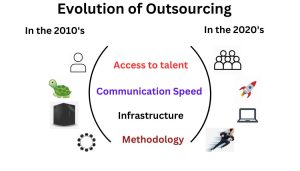
Key ways in which technology has impacted outsourcing software development
The advancements in technology have played a pivotal role in reshaping the outsourcing landscape, and here are some key ways in which technology has impacted outsourcing software development:
- Access to Global Talent Pool: Technology has eliminated geographical barriers, enabling businesses to tap into a vast pool of talent from around the world. With high-speed internet, video conferencing, and collaboration tools, companies can now work seamlessly with offshore development teams. This access to a global talent pool allows businesses to find highly skilled professionals at competitive rates, saving both time and money.
- Enhanced Communication and Collaboration: The advent of communication technologies, such as instant messaging, video conferencing, and project management tools, has revolutionized how outsourcing teams interact and collaborate. Real-time communication enables continuous engagement and fosters a sense of unity among remote team members. Project milestones, updates, and feedback can be shared instantly, ensuring transparency and efficient project management.
- Agile Development Methodologies: Agile methodologies, like Scrum and Kanban, have gained immense popularity in the software development industry. These methodologies promote iterative development, constant feedback, and flexibility in project requirements. Technology-enabled collaboration tools and project management platforms facilitate agile practices and ensure effective coordination between teams, even across different time zones.
- Cloud Computing and Infrastructure: The rise of cloud computing has transformed the outsourcing landscape. Cloud platforms provide scalable infrastructure and on-demand resources, eliminating the need for costly physical infrastructure setup. Development teams can access the necessary computing power and storage remotely, reducing operational costs and increasing overall efficiency.
- Automation and DevOps Practices: Technology has automated several aspects of software development and deployment processes. Continuous integration and continuous delivery (CI/CD) pipelines enable automation of tasks like code testing, building, and deployment. DevOps practices leverage technology to foster collaboration between development and operations teams, streamlining workflows, and ensuring faster time-to-market for software products.
- Security and Intellectual Property Protection: Outsourcing raises concerns about data security and intellectual property (IP) protection. However, advancements in technology have provided solutions to mitigate these risks. Secure communication channels, encrypted file sharing, and access controls safeguard sensitive information. Non-disclosure agreements (NDAs) and legal frameworks protect IP rights, ensuring that businesses retain ownership of their software and proprietary information.
- Machine Learning and Artificial Intelligence: Technology-driven advancements in machine learning (ML) and artificial intelligence (AI) have significantly impacted software development outsourcing. ML algorithms can automate repetitive tasks, data analysis, and quality assurance processes, resulting in faster and more accurate results. AI-powered chatbots and virtual assistants are also increasingly being used to enhance customer support and engagement.
I hope this article on the impact of technology on outsourcing has been helpful to you. If you liked it or want to learn more about Deproinf, please subscribe to stay updated.
Subscribe to DeproinfIf you have specific needs please GIVE US YOUR INFORMATION and we will contact you as soon as possible.
