
Basic steps to achieve a successful digital transformation
Digital transformation and back office automation have been among the priorities of companies for the last years and this trend was exacerbated with the COVID aftermath. However, a high percentage of this effort does not result in a successful digital transformation. In this article I will explain how to achieve a successful digital transformation and what the main benefits are.
Why is a successful digital transformation important?
In lays terms digital transformation is the improvement of business processes, products, and services using technology. In our last post we elaborated on the benefits of back-office automation. Today I will complement that vision by engulfing that concept within the domain of digital transformation in businesses. Let’s start with the benefits of an integrated approach digital transformation + back office automation.
Generates insights based on data: One of the most important benefits of digital transformation is that it allows you to collect and analyze data that can be used in decision making.
Enable high-quality user experience: High-value companies know that the goal is not just deliver products, but positive experiences to the customers.
Encourage collaboration and improve communication: The digital transformation is based on having a digital platform that promotes communication and collaboration in all departments.
Increases operational efficiency: By consolidating manual and integrating back-office systems processes, you reduce costs by that automate processes.
Reduces human error: Digital processes stop errors by eliminating manual data entry that is time consuming and prone to human error.
Enable future digital growth: The ultimate benefit of a successful digital transformation and the most important one is to set the stage for all subsequent business growth.
How to get a successful digital transformation?
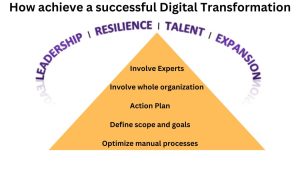
The will to achieve digital transformation is not enough to assure that it will be successful. According to Forbes the risk of failure in digital transformation is in the order of 84%; and according to McKinsey, BCG, KPMG and Bain & Company, it ranges between 70% and 95%. Considering the caliber of these consultants we stress the importance of being prepared before committing to a digital transformation. In our experience a successful digital transformation is a 5 steps process, within a four organizational basis arc, as illustrated below.
Let’s elaborate on this concept.
Organizational traits necessary for a successful digital transformation
Leadership: Digital transformation implies deep changes on the way things are done and employees’ involvement in the process. Without an effective, digital proficient and committed leader these changes will not happen. In our experience, a company with a leader from the top echelon and knowledge of digital changes has 3 times more probabilities of success.
Resilient structure: Resilient organizations are those that rebound and prosper after business disruption, because they’re adaptive, agile and sustainable. The depth of changes involved in a digital transformation have 4 times more chances of success if the organization is a resilient one, as opposed to a “fixed and unmovable” type of company.
Personnel with digital knowledge: Digital transformation involves the whole organization; so, the most knowledge there is the better the possibilities of success. As much as obvious this sound, according to Forbes as many as 84% of digital transformations fails because of lack of proficient talent. In summary: make sure to have the right people before starting your transformation program.
New business expansion: One of the core goals behind digital transformation is to keep the market niche that you have, but also to expand the sources of income by means of additional channel or new digital products. This has to be in place before starting the transformation.
Steps for a successful implementation
Optimize you manual processes: Digital transformation starts with back office automation and it cannot be successful if you do not optimize the manual processes that you will be automating.
Define the scope and goals of the transformation: Be sure that you have clearly identified what you want to digitize and, most important, set reasonable timelines to do it.
Elaborate the action plan: No one can get somewhere without a mapping on how to get there. With something as complex as digital transformation the planning phase is essential.
Involve the whole organization: Make sure that the action plan counts with the approval of all levels involved in the implementation.
Involve experts outside consultants: Even though you have the adequate talent and expertise, digital transformation is so complex that the chances of failure decreases in almost 40% if you incorporate an outsider expert in the process; especially if:
- Your digital products require development.
- The back office automation involves customizations or new software.
Conclusion
Digital transformation is multifaceted, complex, and full of challenges that can make even the most seasoned entrepreneur’s head spin. If you need a push to start the journey, at Grupo Deproinf we can assist you in the process.
I hope this article has been helpful to you. If you liked it or want to learn more about Deproinf, please subscribe to stay updated on future articles and follow us in Instagram.
Subscribe to Deproinf


